There are no two ways around it: in order to be a critical thinker, you need to have a basic understanding about how the universe works. Humans, we crafty little buggers, have developed a method by which we can describe the universe, and thereby come nearer to understanding it. That method is called science, or the so-called "Scientific Method."
There are basic tenets of science, founding principles really, which have been developed and proven in experiment after experiment for many years now. Science, much like the law (insert ironic coughing here), acts like a self-referential sounding board to not only prove these basic tenets, but to prove and refine the proof, increasing the reliability that the tenets actually describe the actual universe actually -- "peer review."
How fine the basic nature of these tenets gets depends a lot on your personal expertise. A mathematician may have cause to question, for instance, whether "1 + 1" actually equals "2," and what "1" means anyway, but that level of inquiry is inefficient for the bulk of us. On the other hand, as to most of us, the fact that the universe is expanding is enough to know, but that may not be an assumption an astrophysicist might want to make in her work.
What is the point, you may ask, of bothering to know much about science. The answer is that a knowledge of basic science can keep you from expensive mistakes. For instance, if you're wondering if someone is selling a useful (product, political system, food replacement therapy, overly expensive water purification system, religion, "alternative medicine" (aka "SCAM"), or power enhancing bracelet), a good first step is to compare the claims to certain tenets and see if the proffered thing meets the sniff test. If it does not, place your wallet firmly back into your pocket. [Interesting: google "how to stop getting ripped off" and you'll be able to spend your hard-earned money on books which teach you the same. Ironic?]
Another, related, answer is that a knowledge of science can help you navigate our technological world. Every day we're heaped with new and better stuff, gizmos, and thingymabobs. Each of them has (a group of) scientists working on the science behind them: materials researchers, computer scientists (said with feeling), electrical engineers, technical support/writers, and even packaging engineers! If you know the basis for the science behind the things you use, you can become a better consumer...besides, its just neat! (No, your iPhone does not work by magic, and is not going to give you cancer.)
Yet another reason to know these things is that it makes you a better person. Smart people are savvy people are people who can speak intelligently on all manner of topics. Smart people can make better choices because their brain is functioning, churning out neurons in an effort to keep up, making more room for more information, and (so I've heard) staving off diseases like Alzheimer's. Smart people can, for instance, differentiate between political rhetoric and political discourse. Smart people can choose the lesser of two evils. Smart people are compassionate and moral.
To come...links to the above points, and an actual LIST of the tenets of science every person should know!

Showing posts with label logic. Show all posts
Showing posts with label logic. Show all posts
Thursday, July 28, 2011


Wednesday, June 1, 2011
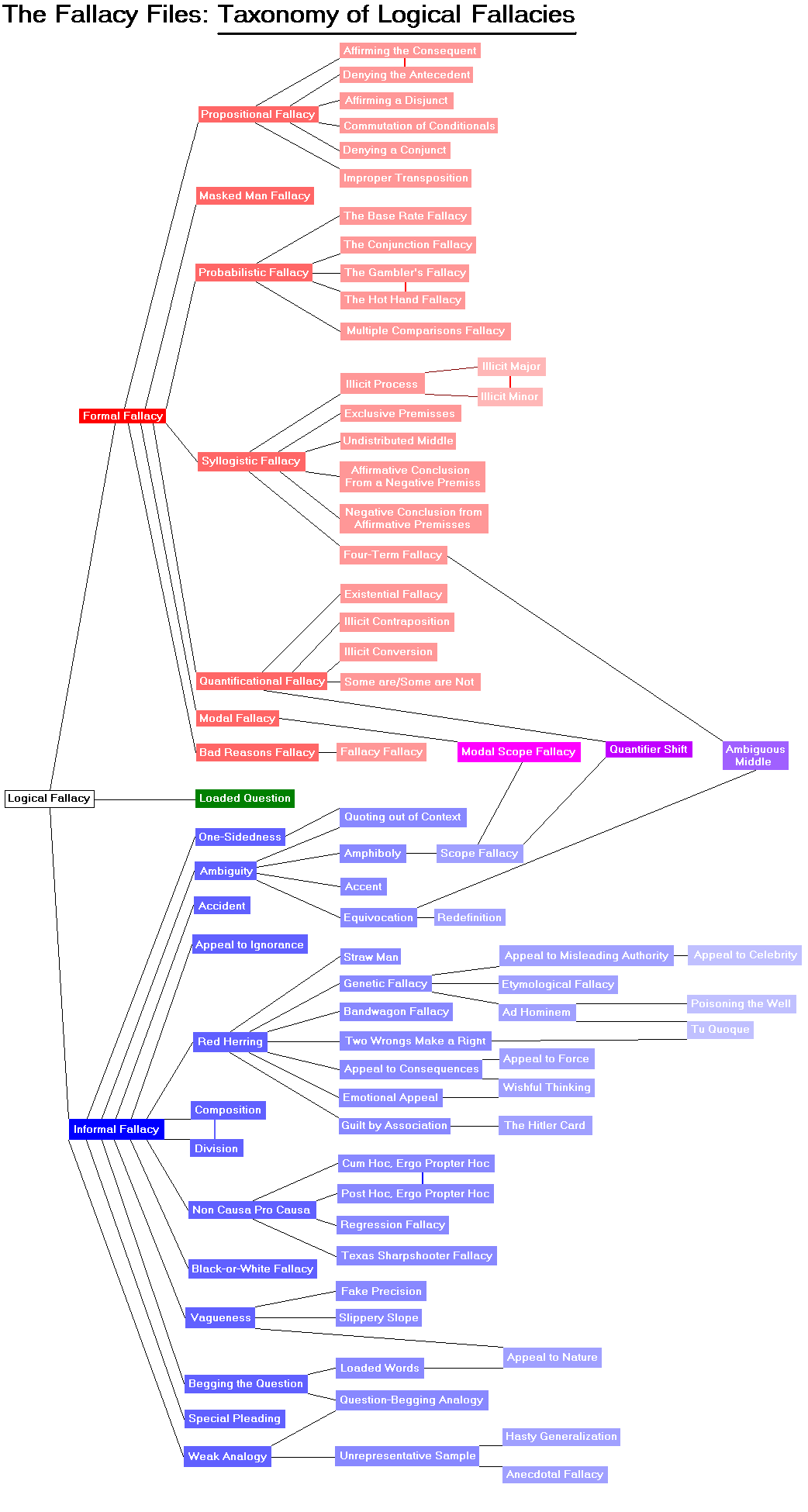
Summary of Logical Fallacies
Why do we study logical fallacies? The reason is simple: to avoid making them, and to avoid being duped by them! I've been writing about those fallacies that have come up in my work, but here is a taxonomic chart of "all" the logical fallacies categorized by type.
 Enjoy it, and see if you can find and correct a logical fallacy in your work today.
Friday, May 14, 2010
False Premise
All logical arguments are based up initial assumptions, called premises, that must be true for the conclusion to be true. Because the initial assumptions must not be false, it is important to scrutinize propositions before stating them. For instance:
The real world is rife with this particular logical fallacy. Often this occurs when people make assumptions about the world around them. In the employment context, this might come up in wage claims, when employees extrapolate what happened to other to themselves; or in discrimination claims when employees make assumptions about another person because of their sex or race.
Watch out for these in all drafting employment manuals, too. Assumptions about how and when people act can accidentally impose contract law onto a poorly crafted handbook.
a. All dogs have rabies. (Premise.)Because (a) is demonstrably false, (c) has to be false under this argument. That doesn't mean the dog mentioned does not have rabies, but it means you cannot prove it as above.
b. Franco is a dog. (Premise.)
c. Franco must have rabies. (Conclusion.)
The real world is rife with this particular logical fallacy. Often this occurs when people make assumptions about the world around them. In the employment context, this might come up in wage claims, when employees extrapolate what happened to other to themselves; or in discrimination claims when employees make assumptions about another person because of their sex or race.
Watch out for these in all drafting employment manuals, too. Assumptions about how and when people act can accidentally impose contract law onto a poorly crafted handbook.
Friday, April 30, 2010
Uncertainty
One of my jobs as a lawyer is to explain the pros and cons of crucial, expensive, and often emotional decisions to employers who have been accused of some wrongful conduct (usually on wage and hour, workers' comp discrimination, other discrimination, wrongful termination, retaliation, or union-related matters). Always, the advise must be informed by the inherent uncertainty in litigation.
When asked for advice on the art of legal practice, I usually tell students to divorce emotion from the process and apply the law to the facts. Even under those circumstances, the no legal issue -- however frivolous -- is 100% certain. How can this be? The answer is manifold: unscrupulous litigants will "bend" facts to suit their needs, even in the absence of such "bending" some facts lend themselves to interpretation (e.g., an innocent comment or gesture can show discriminatory animus if repeated or not properly explained), juries are notoriously emotional bodies, and the court itself is not immune from a policy-based view of the facts.
Taking all that into account, the advice proceeds along the lines of, a discussion of the facts, some application of facts to the law, an explanation of the opponent's best case, an explanation of the process of trial (including discovery, pretrial motions, trial filings, interactions in court, the trial itself, and post-trial filings), followed by a range of budgets for the litigation, including best- and worst-case outcomes.
But in the end, the question comes down to this: will the employer prevail at trial? And the answer to that question can never be "yes." On the other hand, rarely is the answer "no." And this is where the discussion of uncertainty begins. At trial, the best, most logically sound argument can fail for three reasons, two legal and one human: credibility, policy, and emotion.
The spectrum runs from the total uncertainty of trial to the total certainty of the early payment of the opponent's demand. In the end, few cases proceed on either of those paths. Instead, nearly all cases resolve through some sort of informal settlement of the issues or alternative dispute resolution or "ADR." These provide a way for the parties to keep some degree of control in the process, and craft an outcome between them, rather than letting the unknown (but neutral) entities of the court and juries decide.
In the end, the client must make that difficult choice: pay some amount up front, or proceed through litigation and let the court decide. I suspect uncertainty played this same key role in memorium, and suspect it will continue play a key role in perpetuum.
When asked for advice on the art of legal practice, I usually tell students to divorce emotion from the process and apply the law to the facts. Even under those circumstances, the no legal issue -- however frivolous -- is 100% certain. How can this be? The answer is manifold: unscrupulous litigants will "bend" facts to suit their needs, even in the absence of such "bending" some facts lend themselves to interpretation (e.g., an innocent comment or gesture can show discriminatory animus if repeated or not properly explained), juries are notoriously emotional bodies, and the court itself is not immune from a policy-based view of the facts.
Taking all that into account, the advice proceeds along the lines of, a discussion of the facts, some application of facts to the law, an explanation of the opponent's best case, an explanation of the process of trial (including discovery, pretrial motions, trial filings, interactions in court, the trial itself, and post-trial filings), followed by a range of budgets for the litigation, including best- and worst-case outcomes.
But in the end, the question comes down to this: will the employer prevail at trial? And the answer to that question can never be "yes." On the other hand, rarely is the answer "no." And this is where the discussion of uncertainty begins. At trial, the best, most logically sound argument can fail for three reasons, two legal and one human: credibility, policy, and emotion.
The spectrum runs from the total uncertainty of trial to the total certainty of the early payment of the opponent's demand. In the end, few cases proceed on either of those paths. Instead, nearly all cases resolve through some sort of informal settlement of the issues or alternative dispute resolution or "ADR." These provide a way for the parties to keep some degree of control in the process, and craft an outcome between them, rather than letting the unknown (but neutral) entities of the court and juries decide.
In the end, the client must make that difficult choice: pay some amount up front, or proceed through litigation and let the court decide. I suspect uncertainty played this same key role in memorium, and suspect it will continue play a key role in perpetuum.
Tuesday, April 27, 2010
Arguing from Ignorance
Common sense is our most basic fall-back when confronted by things outside our understanding. My boss likes to call it the "sniff test." Does some knew information conform to what we already know? If it does not, we're likely to reject it; if it does, we're more likely to accept it. Rejecting an argument based on a personal failure to understand is the argument from ignorance (specifically an argument from personal incredulity). That argument goes something like this:
- I don't understand a.
- Therefore no one can understand a, and therefore a must be false.
Stated succinctly, the argumentum ad ignorantiam goes:
A premise is true only because it has not been proven false, or is false only because it has not been proven true.That level of sophistication (or lack thereof) may be fine when filtering out the mental cruft of daily life, but when it comes to legal analysis, common sense is insufficient. Instead, a position must be backed up by fact and law. However, the common-sense filtering system may be important to determine which of many arguments to spend the time refuting.
Thursday, April 15, 2010
Correlation Does Not Equal Causation
Among the easiest logical errors to fall into is to assume that because one event followed another, it must have been caused by the first. That logical fallacy is called post hoc ergo propter hoc, or "after which therefore because of". However equally fallacious is the idea that because two events are related in some way, there is a causal relationship between them, which is, instead cum hoc ergo propter hoc ("with this, therefore because of this"). Succinctly stated:
This sort of fallacy comes up in medical practice and statistics frequently. However, it is just as frequently seen in legal arguments -- and as I've mentioned before, we must keep a watchful eye on both our own arguments and those of our opponents.
I often see the case where because an employee was terminated, and because the employee happens to be a member of a protected class (race, sex, disability, etc.), the employee will raise a discrimination claim. The law and logic require more to prove discrimination (as it turns out, the law and logic share a lot in common): there must also be a correlation between the protected class and the termination. The law calls this correlation a nexus ("bond"), defined as a connection between two things.
As always, contact me for more information.
Because two events are related in some way, does not imply a causal relationship among them.
This sort of fallacy comes up in medical practice and statistics frequently. However, it is just as frequently seen in legal arguments -- and as I've mentioned before, we must keep a watchful eye on both our own arguments and those of our opponents.
I often see the case where because an employee was terminated, and because the employee happens to be a member of a protected class (race, sex, disability, etc.), the employee will raise a discrimination claim. The law and logic require more to prove discrimination (as it turns out, the law and logic share a lot in common): there must also be a correlation between the protected class and the termination. The law calls this correlation a nexus ("bond"), defined as a connection between two things.
As always, contact me for more information.
Tuesday, April 6, 2010
Arguing the "Straw Man"
In any debate, two sides argue from two points of view. However, for the debate to be meaningful, the argument must be about the same topic. As such, in order to undermine an opponent's argument, nefarious arguers will try to manipulate the topic, rather than improving their underlying logic.
There are several ways to do this. The most straightforward, and not a logical fallacy itself, is arguing about how to frame the discussion: framing the debate is a threshold issue. However, when the topic itself is co-opted by one side, anything argued by that side thereafter is fallacious, because it does not flow from state premises.
One way of doing this is to argue against a position not taken by your opponent. That is the straw man:
Arguing against a distorted, exaggerated, conclusory, or manufactured position.
The name probably derives from the fighting a man of straw is easier than fighting a real one. But the concept is: if you can frame your opponent's position, you can make him appear foolish while attacking him (and not his arguments). As such, a straw man is a type of ad homenim ("against the person") attack -- I'll write about that one soon.
The employment setting is ripe for straw man arguments. Often employees feel wronged but are unable to articulate why. Similarly, employers just want to get the job done, and so they can easily overlook employee's legitimate needs. Whenever we find ourselves arguing as if the other side had state a position, its important to go back and see what exactly they are saying. On the other hand, being aware of this type of error will prevent the issues being co-opted which can easily misled a busy third party (like the court!).
Wednesday, March 31, 2010
In Defense of the Adversarial System
When I began law school, one of my professors spoke to the student body, and described our legal system as a replacement for the brutality which can come from competition for rights and resources. Absent an active and accessible judiciary, aggrieved parties are relegated to "self help" to resolve disputes. What sort of help is available to that person? If they have the physical strength to accomplish it, the self help involves physically forcing the opponent to comply.
When modern-day litigants wait months or years for resolution of their disputes, they may wish to return to the days of clubs and pistols. However, the Rule of Law has several distinct advantages: it places power in the hands of the less powerful, it grants ultimate judgments to a neutral party, it allows non-parties (the rest of the world) the peace of mind to know that they won't be caught in the cross fire, and it lets the parties know that they can be heard.
How is this accomplished? By replacing weapons with facts, might with precedent, and actions with arguments. Facts are the tools with which the parties pitch battle in modern society, and the law can be used as both a sword and a shield in these fights. And though sometimes the system fails, and the wrong party prevails (and sometimes the system works and the correct party prevails), usually the courts come down somewhere in the middle depending on the shade of grey.
To the outside world, the courts can seem to be a behemoth pumping out justice at a snail's pace. From an employer's perspective, plaintiff's seem to be clogging the courts with frivolous cases just to get a big payoff. While both the court and plaintiffs (and defendants too, for that matter) sometimes act as barriers to justice, on the whole the system works better than the alternative it was designed to replace -- better to lose your shirt than your eye or your head!
One of the regular topics I'll write about is why the system, despite its flaws, functions well for us its patrons.
When modern-day litigants wait months or years for resolution of their disputes, they may wish to return to the days of clubs and pistols. However, the Rule of Law has several distinct advantages: it places power in the hands of the less powerful, it grants ultimate judgments to a neutral party, it allows non-parties (the rest of the world) the peace of mind to know that they won't be caught in the cross fire, and it lets the parties know that they can be heard.
How is this accomplished? By replacing weapons with facts, might with precedent, and actions with arguments. Facts are the tools with which the parties pitch battle in modern society, and the law can be used as both a sword and a shield in these fights. And though sometimes the system fails, and the wrong party prevails (and sometimes the system works and the correct party prevails), usually the courts come down somewhere in the middle depending on the shade of grey.
To the outside world, the courts can seem to be a behemoth pumping out justice at a snail's pace. From an employer's perspective, plaintiff's seem to be clogging the courts with frivolous cases just to get a big payoff. While both the court and plaintiffs (and defendants too, for that matter) sometimes act as barriers to justice, on the whole the system works better than the alternative it was designed to replace -- better to lose your shirt than your eye or your head!
One of the regular topics I'll write about is why the system, despite its flaws, functions well for us its patrons.
Tuesday, March 23, 2010
False Dichotomy
In any debate, including employment litigation, the parties must state their premises. When put to the task, there is not limit to the mistakes -- both deliberate and inadvertent -- which can skew an argument. As such, litigators must be on the lookout for logical fallacies in both opponent's and their own writing and oration. As a primer, I will work on one such fallacy each week.
When stating the premises, the arguer might say something like "If its not A, it must be B." Unless both A and B have been established as the only alternatives, then this statement is false. That is called a false dichotomy or false dilemma. Stated succinctly:
For instance, if an employee's performance become suddenly erratic, and workplace issues are eliminated, presuming the employee has a drinking problem presents a false dichotomy: either the employee had a workplace problem or a drinking problem. On the other hand, when an employee attributes "stress" to his job without proper medical examination: the employee is assuming that work must be he cause, since his home life is good.
The results of an argument from false premises is also false, so be on the lookout for this sort of thinking!
When stating the premises, the arguer might say something like "If its not A, it must be B." Unless both A and B have been established as the only alternatives, then this statement is false. That is called a false dichotomy or false dilemma. Stated succinctly:
Arbitrarily limiting a range of possibilities to only two is a false dichotomy.Similarly, Arbitrarily limiting a range of possibilities to a subset of the whole is a false dilemma. See another definition here.
For instance, if an employee's performance become suddenly erratic, and workplace issues are eliminated, presuming the employee has a drinking problem presents a false dichotomy: either the employee had a workplace problem or a drinking problem. On the other hand, when an employee attributes "stress" to his job without proper medical examination: the employee is assuming that work must be he cause, since his home life is good.
The results of an argument from false premises is also false, so be on the lookout for this sort of thinking!
Friday, March 12, 2010
Occam's Razor
Vital to understanding employee's complaints and the extent of protection afforded by the law is the ability to think critically about the issues. When presented with employee complaints, witness reports, and employment records, it can be difficult to cut through the volume of material and hone in on the important issues. Even when the allegedly harmed employee is completely honest, emotions can often lead to erroneous conclusions -- there are as many ways to thwart logic as there are to support it.
For this reason, employers need a ready logical toolkit to parse the conjectural from the relevant. Almost like a crime-scene, the fresher the facts, the easier it is to find the smoking gun.
The first tool in the logical toolkit is Occam's Razor:
In the context of factual investigations, this principle is essentially one of economy. When asked for the "facts" of events they witnessed, people often embellish, explain, or remember things as they think they ought to have been. A good interviewer can, through questioning, focus on the actual complaint made, and eliminate non sequiturs. This is Occam's Razor at work: finding the correct (i.e. simplest) conclusion by building up a profile of the event in question.
As part of my practice, I regularly interview witnesses -- both adverse and friendly, both informally and under oath -- in employment discrimination, wage-and-hour, and trust fund contributions cases, as well as toward best employment practices.
For this reason, employers need a ready logical toolkit to parse the conjectural from the relevant. Almost like a crime-scene, the fresher the facts, the easier it is to find the smoking gun.
The first tool in the logical toolkit is Occam's Razor:
The simplest conclusion is that most likely true.In Latin, William of Ockham wrote: pluralitas non est ponenda sine necessitate, "plurality should not be posited without necessity," though it has been rewritten many ways.
In the context of factual investigations, this principle is essentially one of economy. When asked for the "facts" of events they witnessed, people often embellish, explain, or remember things as they think they ought to have been. A good interviewer can, through questioning, focus on the actual complaint made, and eliminate non sequiturs. This is Occam's Razor at work: finding the correct (i.e. simplest) conclusion by building up a profile of the event in question.
As part of my practice, I regularly interview witnesses -- both adverse and friendly, both informally and under oath -- in employment discrimination, wage-and-hour, and trust fund contributions cases, as well as toward best employment practices.
Subscribe to:
Posts (Atom)